As we navigate through 2026, the landscape of artificial intelligence is undergoing a profound transformation, moving beyond the digital realm and into the physical world. This shift marks the dawn of embodied intelligence, where AI systems are no longer confined to screens but are integrated into physical bodies, enabling them to interact with and perceive their environment in unprecedented ways. The Physical AI Trends 2026 are characterized by a convergence of advanced robotics, sophisticated AI algorithms, and enhanced sensory capabilities, promising to redefine industries and daily life. We are witnessing a pivotal moment where machines are not just smart, but also physically capable and increasingly autonomous, learning and adapting in real-time physical spaces.
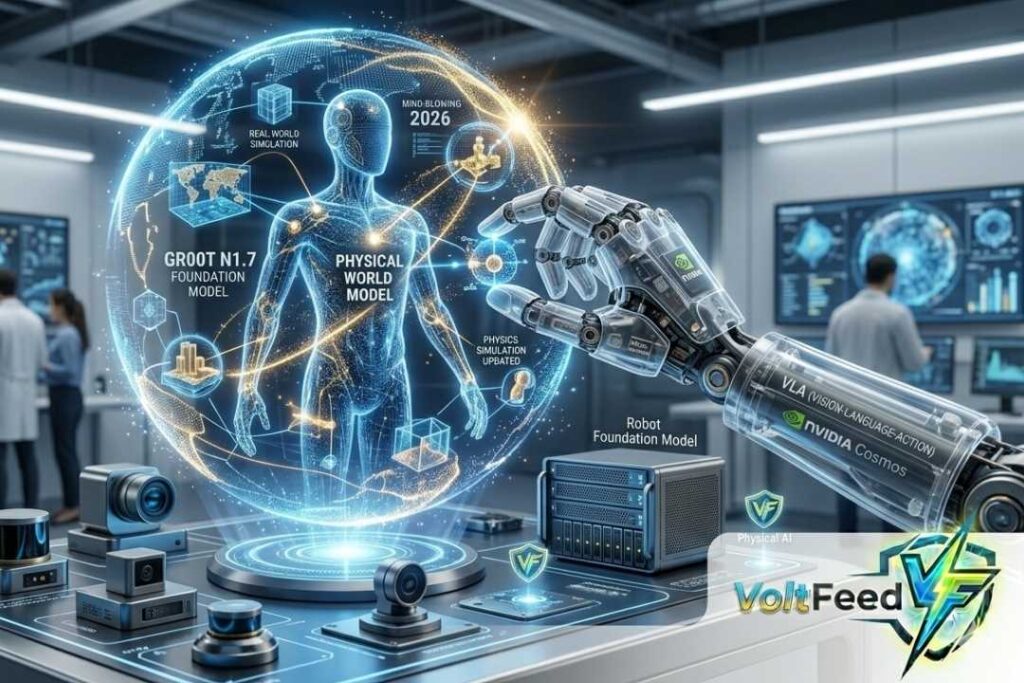
Core Technological Leaps Shaping Physical AI
The rapid evolution of physical AI in 2026 is underpinned by several significant technological advancements:
Advancements in Hardware and Sensory Systems
Physical AI relies heavily on robust and agile hardware. We’re seeing remarkable progress in lightweight materials and modular robotics, allowing for more adaptable and specialized physical AI systems. Enhanced sensory systems, including haptic feedback, advanced computer vision, and multi-modal sensors, are providing robots with a richer understanding of their surroundings, enabling more nuanced and safer interactions. These systems can now process complex environmental data with greater speed and accuracy, mimicking human perception more closely.
Breakthroughs in AI Algorithms for Physical Interaction
The intelligence driving these physical systems has seen dramatic improvements. Reinforcement learning continues to be a cornerstone, allowing robots to learn complex tasks through trial and error in both simulated and real-world environments. Furthermore, advances in foundation models are extending their capabilities to control physical agents, enabling more generalized and adaptable robotic behaviors. We are also observing a greater emphasis on edge AI, where processing power is moved closer to the physical device, reducing latency and enabling quicker decision-making in dynamic environments.
The Role of Simulation and Digital Twins
Simulation environments and digital twin technology are playing an increasingly critical role in the development and deployment of physical AI. These virtual proving grounds allow developers to train and test AI models and robotic systems extensively without the costs and risks associated with real-world prototypes. This accelerates the development cycle, enabling faster iteration and refinement of complex behaviors before physical deployment.
Expanding Applications and the Rise of New Form Factors
The impact of these Physical AI Trends 2026 is evident across a multitude of sectors, leading to the emergence of innovative applications and diverse robotic form factors.
Industrial Automation and Logistics
In manufacturing and logistics, physical AI is moving beyond traditional robotic arms. We’re seeing the widespread adoption of collaborative robots (cobots) that work alongside human employees, enhancing productivity and safety. Autonomous mobile robots (AMRs) are becoming standard in warehouses for picking, sorting, and transportation, optimizing supply chains with their flexibility and efficiency.
Healthcare and Service Robotics
The healthcare sector is experiencing a surge in physical AI applications, from surgical robots offering greater precision to rehabilitation robots assisting patients in recovery. In service industries, physical AI is taking on roles in hospitality, retail, and elder care, with humanoid robots performing tasks like guiding customers, delivering goods, and providing companionship.
Emerging Form Factors
Beyond traditional industrial robots, 2026 is seeing the rise of more specialized and adaptable physical AI forms:
- Soft Robotics: Robots made from compliant materials, capable of delicate manipulation and safe interaction in unstructured environments.
- Bio-inspired Robotics: Systems mimicking natural organisms for locomotion and sensing, opening doors for exploration and environmental monitoring.
- Modular and Swarm Robotics: Individual, simpler robots that can combine or work cooperatively to achieve complex tasks, offering scalability and fault tolerance.
Navigating the Future: Challenges, Ethics, and Investment Landscape
While the advancements in physical AI are exciting, they also bring forth significant challenges and ethical considerations that demand careful navigation.
Technical and Regulatory Hurdles
Developing robust physical AI capable of operating reliably and safely in dynamic, unstructured environments remains a significant technical challenge. Ensuring these systems are resilient to unforeseen circumstances and capable of nuanced decision-making is paramount. From a regulatory standpoint, frameworks for the safe deployment and operation of autonomous physical systems are still evolving, requiring collaboration between industry, government, and academia.
Ethical Considerations and Societal Impact
The increasing autonomy of physical AI raises profound ethical questions. Concerns about job displacement due to automation, the safety of human-robot interaction, and the accountability of AI systems in case of errors are at the forefront. We must proactively address these issues through thoughtful design, transparent operation, and public discourse to ensure physical AI benefits society broadly and equitably.
The Investment Landscape
The investment in physical AI is booming, driven by its transformative potential across industries. Venture capital firms and tech giants are pouring resources into startups specializing in robotics, embodied AI, and related hardware and software. This influx of capital is fueling research and development, accelerating the pace of innovation and bringing more sophisticated physical AI solutions to market.
Frequently Asked Questions (FAQ)
Q: What is the primary difference between traditional AI and physical AI? A: Traditional AI primarily operates in digital domains (e.g., data analysis, language processing), while physical AI integrates AI algorithms with robotic bodies, allowing them to interact with and perform tasks in the real physical world.
Q: How will physical AI impact the job market in 2026? A: Physical AI is expected to automate many repetitive or hazardous tasks, leading to job displacement in some sectors. However, it will also create new jobs in areas such as AI development, robot maintenance, and human-robot collaboration management.
Q: Are physical AI systems truly autonomous? A: While physical AI systems are becoming increasingly autonomous, their level of autonomy varies greatly depending on the application. Many still operate under human supervision or within defined parameters, though fully autonomous capabilities are an active area of research and development.
Conclusion: The Transformative Era of Embodied Intelligence
The Physical AI Trends 2026 point towards a future where embodied intelligence is not just a concept, but a tangible reality reshaping our world. From enhancing industrial productivity and revolutionizing healthcare to performing complex tasks in daily life, physical AI is poised to deliver unprecedented levels of efficiency, safety, and capability. While challenges in technology, ethics, and regulation remain, the rapid pace of innovation and significant investment signal a transformative era. We are collectively moving into a future where intelligent machines are not merely tools, but active, physical participants in our environment, promising to unlock new possibilities and redefine the boundaries of what is achievable.