Apple has consistently pushed the boundaries of silicon innovation, and the introduction of the Apple M5 AI Chip marks another significant leap forward in this journey. This next-generation system on a chip (SoC) is meticulously designed to elevate artificial intelligence (AI) performance across Apple’s product lineup, delivering unparalleled speed, efficiency, and capability. Built on advanced third-generation 3-nanometer technology, the M5 chip family, including the base M5, M5 Pro, and M5 Max, represents Apple’s commitment to integrating powerful, on-device AI experiences.
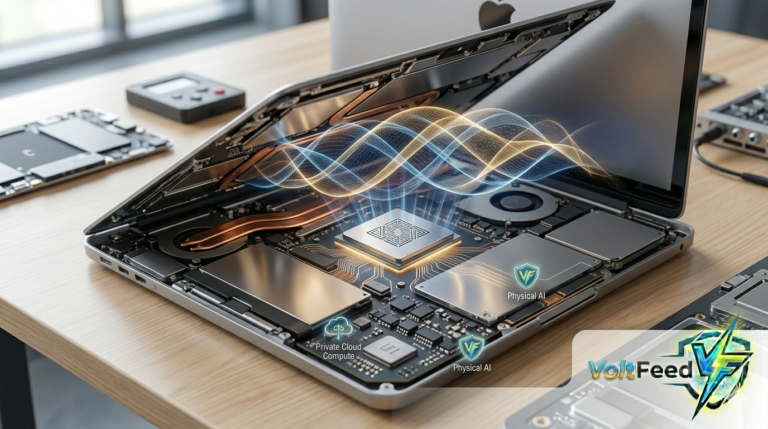
The base M5 chip made its debut on October 15, 2025, powering the new 14-inch MacBook Pro, iPad Pro, and Apple Vision Pro. Following this, on March 3, 2026, Apple unveiled the M5 Pro and M5 Max chips, designed for the more demanding workflows of the updated 14-inch and 16-inch MacBook Pro models, and the M5 also arrived in the new MacBook Air. This strategic rollout underscores Apple’s vision for a future where advanced AI capabilities are seamlessly integrated into our daily computing experiences.
M5’s AI-Centric Architecture: A Closer Look
The core of the Apple M5 AI Chip’s prowess lies in its sophisticated architecture, which has been re-engineered with a profound focus on AI and machine learning tasks.
Revolutionary CPU and GPU Enhancements
The M5 chip family introduces substantial improvements to both its Central Processing Unit (CPU) and Graphics Processing Unit (GPU). The base M5 features up to a 10-core CPU, comprising up to four high-performance “super cores” and six efficiency cores, resulting in up to 15% faster multithreaded performance compared to the M4. The M5 Pro and M5 Max take this further with an 18-core CPU, boasting six “super cores” and twelve efficiency cores, delivering up to a 30% increase in multithreaded performance over the M4 generation. Apple has rebranded its highest-performance cores as “super cores,” emphasizing their industry-leading single-threaded performance.
However, the most groundbreaking advancements for AI are found within the GPU. The M5 introduces a next-generation 10-core GPU architecture that now integrates a Neural Accelerator in each core. This innovative design dramatically boosts GPU-based AI workloads, achieving over 4x the peak GPU compute performance for AI compared to the M4. The M5 Pro and M5 Max further scale this, with up to 20 and 40 GPU cores respectively, each also featuring a Neural Accelerator, offering a similar over 4x peak AI compute performance improvement compared to their M4 predecessors. Beyond AI, the M5 GPU also delivers enhanced graphics capabilities, including third-generation ray tracing, which can provide up to 45% higher graphics performance in ray-traced applications compared to the M4.
Advanced Neural Engine and Unified Memory
The Apple M5 AI Chip also incorporates an improved 16-core Neural Engine, a dedicated component specifically designed to accelerate machine learning tasks. This, combined with the new Neural Accelerators in the GPU, positions the M5 as Apple’s most powerful AI chip to date.
Unified memory also sees significant upgrades, which is crucial for handling the large datasets often associated with AI workloads. The M5 boasts a nearly 30% increase in unified memory bandwidth, reaching 153GB/s. For the professional-grade chips, the M5 Pro supports up to 64GB of unified memory with a bandwidth of 307GB/s, while the M5 Max retains its 128GB maximum capacity but elevates bandwidth to an impressive 614GB/s. This increased bandwidth is vital for demanding tasks such as local Large Language Model (LLM) inference and diffusion model image generation.
Fusion Architecture for Pro Chips
A notable architectural advancement for the M5 Pro and M5 Max chips is the introduction of a new Fusion Architecture. This innovative design bonds two third-generation 3nm dies into a single system on a chip, allowing for scalable capabilities across the CPU, GPU, Media Engine, Neural Engine, unified memory controller, and Thunderbolt 5 capabilities.
Real-World AI Capabilities and Device Integration
The power of the Apple M5 AI Chip translates into tangible, real-world benefits across a range of Apple devices, particularly for tasks involving artificial intelligence.
We can observe the M5’s impact across various devices:
- 14-inch MacBook Pro, iPad Pro, and Apple Vision Pro: These devices were among the first to feature the base M5 chip, enabling significantly faster AI performance for tasks like real-time LLM inference and image generation.
- MacBook Air: The M5 chip brings enhanced performance and even faster AI capabilities to Apple’s popular laptop, powering through everyday productivity and creative workloads.
- 14-inch and 16-inch MacBook Pro (M5 Pro and M5 Max): For creative professionals and users demanding the highest performance, the M5 Pro and M5 Max chips unlock new levels of capability. Apple claims up to 3.5 times faster AI performance in these devices compared to previous generations, with gains tied specifically to real-time LLM inference and image generation.
- Upcoming Mac mini and Mac Studio: Future updates to the Mac mini and Mac Studio are expected to incorporate M5 series chips, bringing noticeable gains in graphics and AI performance to these desktop machines, with a focus on accelerating tasks such as image generation, video processing, and machine learning workloads.
The M5’s enhanced AI capabilities are designed to accelerate a wide array of applications, from advanced computational photography and video editing to complex machine learning models, making devices more intelligent and responsive.
Frequently Asked Questions (FAQ)
Here are some common questions about the Apple M5 AI Chip:
- When was the Apple M5 chip announced? The base Apple M5 chip was announced on October 15, 2025, while the M5 Pro and M5 Max were announced on March 3, 2026.
- Which devices feature the Apple M5 chip? The base M5 chip is found in the 14-inch MacBook Pro, iPad Pro, Apple Vision Pro, and MacBook Air. The M5 Pro and M5 Max are available in the 14-inch and 16-inch MacBook Pro models. Future Mac mini and Mac Studio updates are also expected to feature M5 chips.
- How much faster is the M5’s AI performance compared to previous generations? The M5 chip delivers over 4x the peak GPU compute performance for AI compared to the M4. The M5 Pro and M5 Max also show similar gains over their respective M4 predecessors.
- What is the “Neural Accelerator in each core” in the M5’s GPU? This refers to dedicated hardware units within each GPU core that are specifically designed to accelerate AI and machine learning tasks. They can be programmed via Metal’s updated tensor APIs and used with Core ML and Metal Performance Shaders to run LLMs, generate images, and accelerate other ML tasks.
- What is the “Fusion Architecture” in the M5 Pro and M5 Max? The Fusion Architecture is an innovative design that bonds two third-generation 3nm dies into a single system on a chip, allowing for greater scalability and performance across all components.
Conclusion: Apple’s Expanding AI Ecosystem
The Apple M5 AI Chip represents a significant milestone in Apple’s continuous pursuit of integrating powerful artificial intelligence into its ecosystem. By focusing on a dedicated AI-centric architecture, including “super cores” in the CPU, Neural Accelerators within every GPU core, and an enhanced Neural Engine, Apple has engineered a chip family that is not only faster but also fundamentally more intelligent.
The M5’s debut across the MacBook Pro, iPad Pro, MacBook Air, and Apple Vision Pro, with further integration anticipated for the Mac mini and Mac Studio, demonstrates Apple’s commitment to delivering cutting-edge AI capabilities directly to its users. These advancements are set to redefine how we interact with our devices, enabling more sophisticated on-device AI experiences, faster processing of complex machine learning models, and a more responsive and intuitive user experience across the board. The M5 family solidifies Apple’s position at the forefront of the AI-powered computing era, setting new benchmarks for performance and efficiency in the world of personal technology.