The year 2026 marks a pivotal moment in the quest for revolutionary energy storage, with significant advancements in quantum battery technology. Scientists have made substantial strides, moving this once theoretical concept closer to practical reality. This year, we’ve witnessed the world’s first proof-of-concept quantum battery capable of completing a full charge-store-discharge cycle, a breakthrough that could redefine how we power our world.
The Quantum Battery Revolution: A 2026 Perspective
For decades, our energy landscape has been dominated by electrochemical batteries, primarily lithium-ion. While effective, these conventional batteries face inherent limitations in charging speed, lifespan, and energy density. The promise of quantum batteries, however, offers a glimpse into a future where these constraints are dramatically overcome. This Quantum Battery Breakthrough 2026 is not merely an incremental improvement; it represents a fundamental shift in energy storage, leveraging the enigmatic rules of quantum mechanics.
Australian scientists, notably a team from CSIRO, RMIT University, and the University of Melbourne, have been at the forefront of this revolution. In March 2026, they successfully demonstrated a functional prototype of a quantum battery, validating years of theoretical predictions. This achievement showcases a device that can charge, store, and discharge energy, mirroring conventional batteries but operating on entirely different principles. This breakthrough lays the groundwork for next-generation energy solutions, promising rapid and scalable charging at room temperature.
How Quantum Batteries Work and Their Potential Impact
Unlike traditional batteries that rely on chemical reactions and the flow of electrons, quantum batteries store energy from photons and harness the peculiar properties of quantum mechanics. Key quantum phenomena at play include:
- Superposition: Quantum particles can exist in multiple states simultaneously, potentially allowing quantum batteries to store more energy in the same physical space.
- Entanglement: This “spooky action at a distance” means that particles can be interconnected, influencing each other regardless of separation. This collective behavior is crucial because it allows quantum batteries to charge faster as their size increases – a counterintuitive advantage compared to conventional batteries. This effect, known as superabsorption, enables rapid energy absorption by the system as a whole.
- Quantum Tunneling: This phenomenon allows electrons to pass through energy barriers that would stop them in classical batteries, enabling faster charge/discharge cycles.
The potential impact of this Quantum Battery Breakthrough 2026 is transformative across various sectors:
- Electric Vehicles (EVs): Imagine EVs charging in seconds or minutes, eliminating range anxiety and making long road trips seamless. Dr. James Quach, a leading researcher, envisions a future where electric cars charge faster than petrol cars refuel.
- Consumer Electronics: Devices like smartphones, laptops, and wearables could last days or weeks on a single charge, enhancing user convenience.
- Renewable Energy Systems: Quantum batteries could significantly improve the efficiency of solar cells by enhancing light capture and provide more effective storage for solar and wind energy, balancing power grids.
- Quantum Computing: Quantum batteries could provide the specialized, rapid, and efficient energy transfer needed for quantum computers, potentially making them faster, more reliable, and energy-efficient.
Current Research, Challenges, and the Road to Commercialization
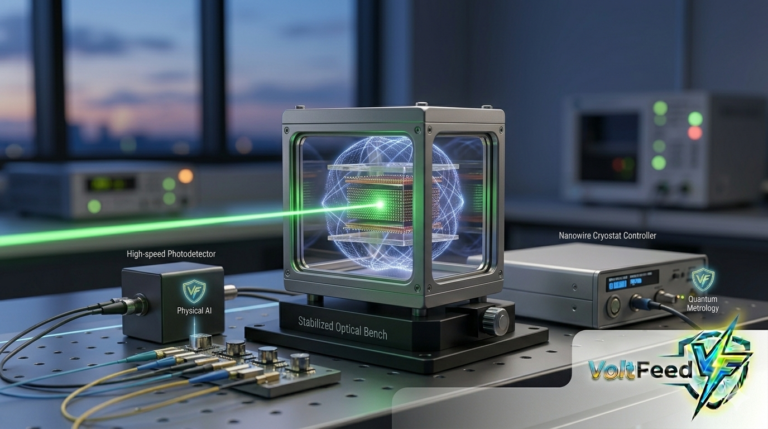
The recent proof-of-concept quantum battery by Australian scientists, which charges wirelessly with a laser and uses a multi-layered organic microcavity, represents a significant step. Another approach demonstrated by researchers in China and Spain uses superconducting qubits, charging twice as fast as classical equivalents. Advances in superconducting qubit technology at Princeton University, achieving longer coherence times, may also indirectly benefit quantum battery development by addressing storage duration challenges.
Despite the excitement, the path to commercialization is fraught with challenges:
- Energy Retention: A primary hurdle is extending the energy storage time. While prototypes can charge in femtoseconds (a quadrillionth of a second) and retain charge for nanoseconds, the goal is to extend this significantly. Dr. Quach emphasizes that the next step is “extending their energy storage time.”
- Decoherence: Quantum states are notoriously fragile and susceptible to decoherence, where a quantum system begins to behave like a classical one, degrading performance. Maintaining quantum coherence over extended periods is critical.
- Scalability and Manufacturing: Scaling quantum systems to real-world battery sizes remains a significant technical limitation. The development costs are high, and prototypes are still in early stages, with mass-market rollout projected over the next decade, potentially by 2040 for widespread consumer reality.
- Integration: Integrating quantum batteries with existing infrastructure and ensuring durability in real-world environments with external noise and temperature fluctuations are crucial engineering challenges.
The global quantum battery market, valued at $18.5 million in 2024, is projected to reach $65.4 million by 2030, with a Compound Annual Growth Rate (CAGR) of 24.5%. This growth is driven by the rise of EVs, the need for clean energy storage, and advancements in quantum computing. However, some researchers caution that quantum batteries may not replace conventional batteries for everyday appliances soon, as they require careful quantum control typically found only in laboratories.
Frequently Asked Questions & The Future Outlook
Q: Will quantum batteries replace my smartphone battery soon?
A: While the potential for instantaneous charging is exciting, quantum batteries are currently in the proof-of-concept stage. Commercialization for everyday consumer electronics is likely still many years away, with some projections suggesting widespread adoption by 2040.
Q: Can quantum batteries power electric vehicles?
A: In theory, yes, with the promise of super-fast charging. However, scaling the technology to power large objects like electric vehicles and ensuring long-term energy retention are significant challenges that researchers are actively working to overcome.
Q: What makes quantum batteries “quantum”?
A: Unlike traditional batteries that use chemical reactions, quantum batteries leverage principles of quantum mechanics such as superposition, entanglement, and superabsorption to store and release energy. This allows for unique properties like charging faster as they get larger.
The Quantum Battery Breakthrough 2026 has undeniably ignited hope for a future where energy storage is no longer a bottleneck. While significant hurdles remain, the recent experimental validations provide a strong foundation for continued research and development. The trajectory is clear: quantum batteries are moving from theoretical curiosity to laboratory demonstration and, eventually, to commercial development. We anticipate a future where abundant, fast-charging, and durable energy storage transforms everything from personal devices to global energy grids, making previously impossible applications a reality.