The landscape of artificial intelligence is rapidly evolving, moving beyond predictive models and generative content creation to a new frontier: Agentic AI Production. This advanced form of AI is designed to operate autonomously, making decisions and taking actions to achieve specific goals with limited human intervention. Unlike traditional AI, which often requires step-by-step guidance, agentic AI systems are proactive, capable of breaking down complex objectives into manageable steps and executing them in dynamic environments. We are witnessing a fundamental shift from mere automation to true autonomy, where AI agents can perceive their environment, reason, plan, act, and learn from their experiences.
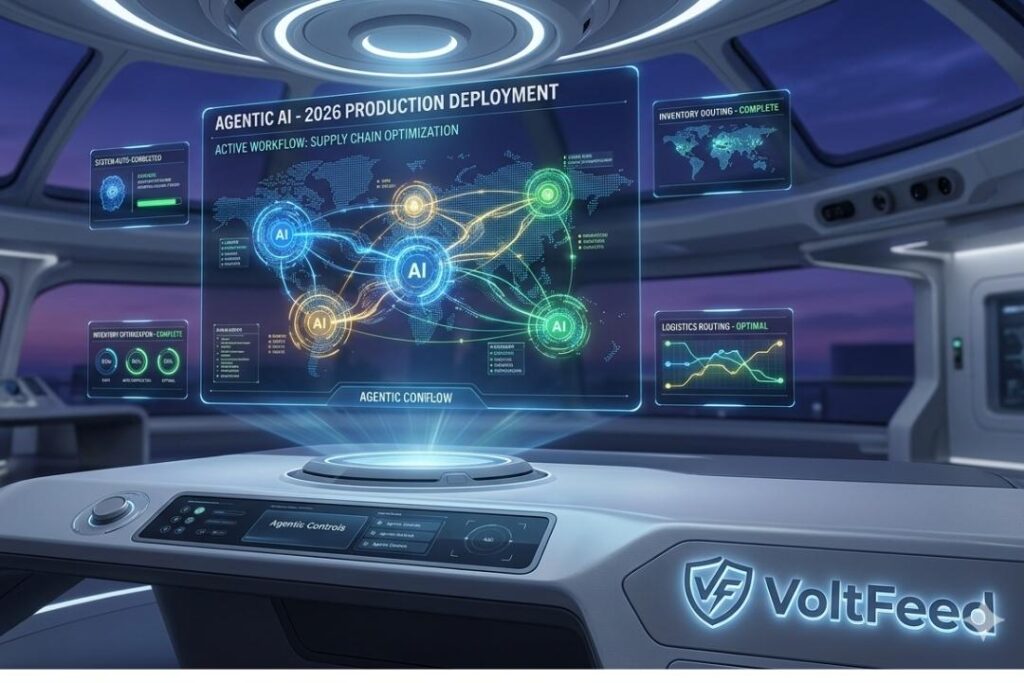
The significance of Agentic AI in production cannot be overstated. It represents the next phase of enterprise AI adoption, transitioning organizations beyond basic chatbots and pilot projects toward intelligent systems that can orchestrate entire workflows. Experts like Ruchir Puri, Chief Scientist at IBM Research, predicted that “2025 will be the year of agents,” highlighting the growing momentum behind this technology. Indeed, the market is experiencing explosive growth, with the global AI agents market projected to exceed USD 10.9 billion in 2026 and reach $199.05 billion by 2034, expanding at a compound annual growth rate (CAGR) of 43.84%. This rapid expansion underscores the transformative potential of Agentic AI Production across various sectors.
Capabilities and Transformative Impact Across Industries
Agentic AI systems are not merely tools; they are intelligent entities capable of independent action, adaptability, and continuous learning. They build upon generative AI techniques by using large language models (LLMs) to function in dynamic environments, extending the capability of generative outputs toward specific goals. This means an agentic AI system can not only generate content but also use that content to complete complex tasks autonomously by calling external tools.
The capabilities of Agentic AI are vast and its transformative impact is being felt across numerous industries:
- Manufacturing: Agentic AI is revolutionizing manufacturing by enabling increased factory autonomy, managing entire production lines with minimal human intervention, and adapting to real-time market demands. It optimizes production, quality, and innovation, proactively predicting equipment breakdowns and lowering downtime by up to 40%. Deloitte notes that agentic AI can transform smart manufacturing from a data-rich to a decision-rich environment, functioning as “digital full-time equivalents” that actively sense, reason, negotiate, decide, and act across interconnected processes.
- Customer Service: Agentic AI is a game-changer for customer service, paving the way for autonomous and low-effort customer experiences. Gartner predicts that by 2029, agentic AI will autonomously handle 80% of routine customer service issues, potentially cutting operational costs by up to 30%.
- Healthcare: In healthcare, agentic AI is experiencing rapid growth, with a projected 35-40% CAGR between 2025 and 2030. It can monitor patient data, adjust treatment recommendations, and significantly reduce administrative workloads for doctors (30%), nurses (39%), and administrative staff (28%).
- Finance and Banking: Agentic AI provides real-time analytics and predictive insights, empowering companies to make faster, data-driven decisions without manual intervention. It’s crucial in fraud detection, identifying sophisticated threats like deepfakes and social engineering attacks in real-time, and adapting to new fraud patterns. In fact, AI-driven systems can reduce response times for fraud incidents by up to 25% compared to traditional methods.
- Software and Technology: Agentic AI systems assist developers by autonomously writing code snippets, identifying bugs, suggesting optimizations, and maintaining complex codebases, significantly reducing development cycles and costs.
Effective AI agents can accelerate business processes by 30% to 50%. This technology is transforming core tech platforms from static systems to dynamic ecosystems that can optimize and adapt instantaneously. By 2028, at least 15% of day-to-day work decisions are expected to be made autonomously through agentic AI, up from 0% in 2024, representing a fundamental shift in business operations.
Navigating the Production Landscape: Challenges and Best Practices
While the promise of Agentic AI Production is immense, its implementation in real-world scenarios presents several significant challenges. We must approach this new technology with a clear understanding of these hurdles to ensure successful deployment.
Key Challenges
- Orchestration Complexity: As multi-agent systems grow, the complexity of orchestrating their interactions explodes rapidly. Coordinating multiple specialized agents, each with its own goals and decision-making logic, can degrade into chaos if not managed effectively.
- Observability and Evaluation: It’s difficult to gain deep, real-time visibility into how agentic systems perceive, reason, and act. Traditional monitoring tools often lack the capabilities to trace decisions or ensure reliability across multi-step, cross-system agentic workflows. Evaluation and testing remain open problems, with a need for robust frameworks including simulations, adversarial testing, and red-teaming.
- Cost Management: Agentic systems can be expensive to run at scale due to the frequent calls to large language models (LLMs) for each agent action. Token costs can add up surprisingly fast when agents chain together many steps per request.
- Governance and Safety Guardrails: Agentic AI systems can take real actions in the real world, such as sending emails or modifying databases, raising significant safety implications. Governance frameworks often lag behind the rapid deployment of these capabilities, making it challenging to implement robust guardrails that prevent harmful actions without being overly restrictive. Concerns about accountability, auditability, and compliance become urgent as agentic systems directly affect customers.
- System Integration: Agentic AI agents need to seamlessly interact with a multitude of tools, APIs, and legacy systems. Many legacy systems may lack modern, accessible APIs, complicating the integration process.
- Data Quality and Readiness: Agents rely on accurate, structured, and accessible data to make decisions. Enterprises often struggle with siloed, missing, or outdated data, which can lead to agents hallucinating or misfiring.
- Maintaining and Adapting Agents: The ongoing maintenance and adaptation of agentic systems can be akin to “building a skyscraper on quicksand”. Current models offer no clear solution for managing and modifying agents, especially when dealing with cascading changes from high-level prompts.
Best Practices for Implementation
To navigate these challenges, we can adopt several best practices:
- Start with High-Impact, Focused Use Cases: Begin with small, well-defined tasks where feedback is easy to gather and the cost of error is relatively low. Look for routine tasks that prevent human employees from doing higher-value work.
- Embrace Human-in-the-Loop Oversight: Autonomy doesn’t eliminate the need for people; it makes their role more important. For high-stakes decisions, humans should remain in the approval chain. This builds trust and ensures brand safety, compliance, and accountability.
- Design for Collaboration, Not Full Autonomy: AI agents are most effective when they augment, rather than replace, human expertise. Workflows should balance automation with human oversight, with agents handling repetitive tasks and humans applying judgment and providing approvals.
- Build on Robust, Secure Infrastructure: Agentic AI success depends on a solid foundation, including reliable data access, context management, and tool integration. Organizations must ensure high-bandwidth connectivity, edge computing, and low-latency networks, especially in operational technology (OT) environments.
- Specialize Agents: Avoid trying to build “super-agents” that do everything. Instead, design agents with narrow, well-defined roles to better control outputs and lower the risk of error.
- Establish Clear Governance and Ethical Frameworks: Develop clear escalation protocols for AI-driven decisions and implement real-time monitoring dashboards for visibility into agent actions. Governance ensures accountability, ethical alignment, and regulatory compliance.
- Prioritize Data Quality and Standardization: High-quality, diverse, unbiased, and well-curated datasets are essential for training agents and eliminating systemic bias. Converting data into standard, structured formats is crucial for agents to identify data sources and maintain consistency.
- Implement Continuous Monitoring and Feedback Loops: Define key performance indicators (KPIs) and establish structured feedback loops to track and improve agent performance. This includes real-time monitoring, data-driven diagnostics, and user feedback to identify errors and refine agent behavior.
- Upskill the Workforce: Implementing agentic AI requires new skills and organizational capabilities. Targeted training and proactive change management initiatives are essential to empower employees to collaborate effectively with advanced AI systems.
Frequently Asked Questions (FAQ)
What is the difference between Agentic AI and Generative AI?
Generative AI focuses on creating new content, such as text, images, or code, based on prompts. Agentic AI, on the other hand, uses generative models as a reasoning engine to go a step further: it autonomously plans and takes actions in the real world to achieve a specific goal. You can think of generative AI as the “brain” and agentic AI as the “body” that allows the brain to interact with the world.
Can AI agents perform actions completely on their own?
Yes, when equipped with robust orchestration tools and within programmed guardrails and granted permissions, AI agents can execute code, send emails, query databases, or scrape the web independently. However, full autonomy without any human supervision remains a goal for the future, and human oversight is crucial for high-stakes decisions.
What are the main risks associated with Agentic AI Production?
Primary risks include the lack of determinism, “hallucinated” actions (e.g., executing destructive database queries or sending incorrect emails), security vulnerabilities via prompt injection, and the difficulty of applying strict compliance auditing to non-linear agentic workflows. There are also concerns about trust, transparency, and the potential for cascading errors if a single faulty agent triggers issues across the enterprise.
How do we measure the ROI of agentic AI initiatives?
Measuring the ROI of agentic initiatives involves defining business-aligned metrics such as cost savings, accuracy, and customer satisfaction. Companies report average returns on investment (ROI) of 171%, with U.S. enterprises achieving 192% ROI from agentic deployments. Early adopters have seen impressive results, including 20% to 30% faster workflow cycles and significant reductions in back-office costs.