The landscape of smartphone technology is constantly evolving, pushing the boundaries of what these ubiquitous devices can achieve. While artificial intelligence (AI) has become a common feature, integrated into everything from camera enhancements to voice assistants, a new paradigm is emerging: embodied AI. This revolutionary approach aims to move beyond mere digital intelligence, allowing devices to interact with the world through physical motion and environmental awareness. Leading this charge is Honor, with its groundbreaking Honor Robot Phone, a concept device that hints at a future where our smartphones are not just smart, but also physically expressive companions.
The Honor Robot Phone: A Fusion of Robotics and Intelligence
Unveiled as a prototype at MWC 2026, the Honor Robot Phone represents a bold exploration into the convergence of smartphone functionality and robotics. It’s more than just a phone with advanced AI; it’s a “new species of smartphone” designed to integrate motion and spatial awareness. Unlike traditional smartphones that rely solely on screens and voice commands for interaction, this device is engineered to respond and engage through physical movement, offering a more human-like and expressive experience.
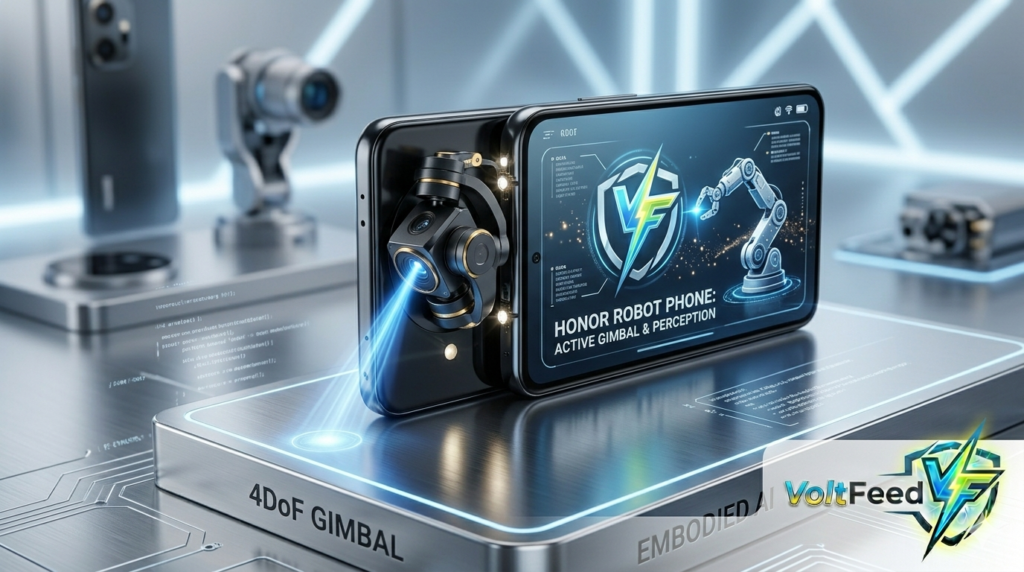
At its core, the Honor Robot Phone features a sophisticated robotic arm that deploys from its back, housing a high-resolution camera. This arm is equipped with a micro-motor system and a compact four-degree-of-freedom gimbal mechanism, enabling the camera module to physically rotate, reposition, and move freely in three dimensions.
This innovative design allows for features like hands-free framing and automated motion-tracking during video calls or content capture, ensuring subjects remain perfectly centered and stable. Honor envisions this as an early step towards “embodied AI,” where devices can detect sound and motion while maintaining visual tracking, offering a truly multimodal sensing capability. Demonstrations have even showcased the device performing gestures such as gazing, nodding, dancing, and shaking its head, further highlighting its expressive potential.
Powering the Future: Technology and Innovation
The advanced capabilities of the Honor Robot Phone are underpinned by significant technological innovation. Miniaturizing complex robotic functionality to fit within a handheld smartphone form factor presented a considerable engineering challenge. Honor addressed this by developing a compact actuator capable of driving the internal gimbal system, all while adhering to the size constraints of a smartphone.
Key technological aspects include:
- Micro-Motor System: A highly miniaturized motor system is crucial for enabling the robotic movements of the camera module.
- Four-Degree-of-Freedom Gimbal: This advanced mechanical gimbal allows for precise and fluid motion control, providing stability and flexibility for the integrated camera.
- AI-Based Object Tracking: The phone leverages AI algorithms for real-time object tracking, allowing the camera to autonomously follow subjects and maintain optimal framing.
- Multimodal Sensing: The device is equipped to understand its environment by detecting both sound and motion, which informs its physical responses and camera movements.
- High-Resolution Camera: A 200-megapixel camera is integrated into the robotic arm, promising professional-grade photography and advanced cinematic imaging capabilities.
- ARRI Collaboration: Honor’s partnership with cinema equipment manufacturer Arri is expected to bring enhanced imaging capabilities, including improved video capturing and color science, to the Robot Phone.
This fusion of hardware and AI represents Honor’s commitment to its “Augmented Human Intelligence” (AHI) vision, aiming to create devices that are more intuitive and responsive to human needs.
Market Impact and Future Prospects
The Honor Robot Phone, while currently a concept, is slated for a commercial launch in China in the second half of 2026, with an expected release window between July and September. This launch could mark a significant turning point in the smartphone industry, potentially challenging existing notions of mobile device interaction.
The market impact of such a device could be substantial:
- Redefining User Interaction: By adding physical motion to AI, the Honor Robot Phone could introduce a new dimension of user engagement, moving beyond traditional touch and voice interfaces.
- Enhanced Content Creation: For vloggers, content creators, and casual users alike, the integrated gimbal and AI tracking could simplify professional-looking video capture, making advanced cinematography more accessible.
- Competitive Edge: As smartphone manufacturers increasingly integrate AI, the Honor Robot Phone offers a unique hardware-driven differentiation that could set Honor apart from competitors, including major players like Apple.
- Foundation for Future Robotics: The miniaturization and integration of robotic components into a smartphone could pave the way for even more sophisticated embodied AI devices in the future, blurring the lines between personal electronics and personal robots.
Honor CEO James Li has emphasized that the company is exploring a “new paradigm of AI devices with Alpha Phone,” and the Honor Robot Phone is a tangible manifestation of this vision. While the engineering challenges for mass production, such as durability and maintaining a slim form factor, are significant, the intent is clear: to bring this innovative product to market.
Frequently Asked Questions about the Honor Robot Phone
To help us understand this exciting new concept, let’s address some common questions:
Q: Is the Honor Robot Phone a real product I can buy today? A: No, the Honor Robot Phone is currently a prototype or concept device. Honor showcased it at MWC 2026 and plans for a commercial launch in China in the second half of 2026.
Q: What makes the Honor Robot Phone different from other AI smartphones? A: While many smartphones have AI features (like Honor’s Magic 6 Pro with AI Eraser and Magic Portal), the Honor Robot Phone stands out due to its physical robotic capabilities. It integrates a motorized gimbal arm that allows its camera to move autonomously, offering “embodied AI interaction”.
Q: What are the main features of its robotic camera? A: The camera is a 200-megapixel sensor mounted on a four-degree-of-freedom gimbal. It can rotate, reposition, and track subjects using AI, enabling hands-free video calls, motion-tracking, and stabilized footage.
Q: What is “embodied AI”? A: Embodied AI refers to artificial intelligence that operates within a physical body, allowing it to interact with the real world through movement, sensing, and physical actions, rather than just through digital interfaces.
Q: Will it be durable with moving parts? A: Integrating complex mechanical structures into a smartphone presents challenges for durability and water/dust resistance. Honor is applying high-performance materials and reliability expertise developed for its foldable phones to the Robot Phone engineering, aiming for robustness.
Conclusion: Redefining the Smartphone Experience
The Honor Robot Phone represents a bold leap into the future of mobile technology. By merging advanced robotics with sophisticated artificial intelligence, Honor is not just creating a new smartphone; it is envisioning a “new species of smartphone” that promises a more interactive, intuitive, and physically responsive user experience. As we move towards a future where AI becomes increasingly integrated into our daily lives, devices like the Honor Robot Phone underscore a pivotal shift: from passive tools to active, embodied companions. We eagerly anticipate its commercial debut, which could truly redefine our expectations of what a smartphone can be.