As we continue to integrate 5G networks into our daily lives, the world of telecommunications is already looking ahead to the next frontier: 6G. This sixth generation of wireless technology promises to be more than just an incremental upgrade; it represents a fundamental shift in how we interact with the digital and physical worlds. Expected to become commercially available by the early 2030s, 6G is poised to deliver unprecedented capabilities that will redefine connectivity, intelligence, and human-machine interaction. We are on the cusp of a hyper-connected future, where the boundaries between reality and the digital realm will blur, driven by the immense power of 6G network speed and its innovative features.
Unprecedented Speed and Ultra-Low Latency
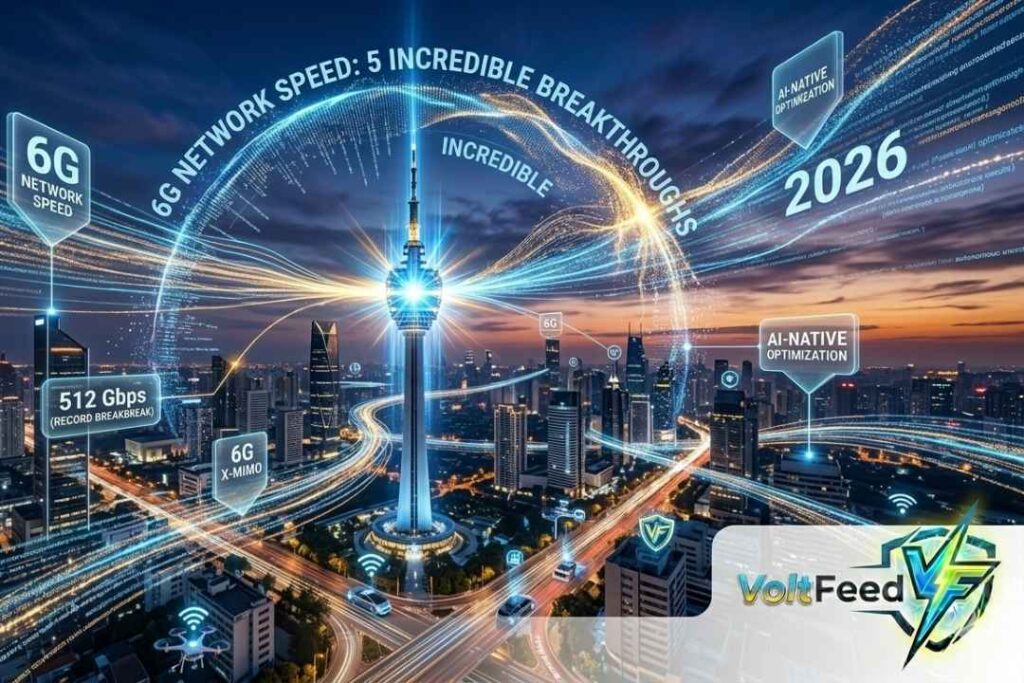
The most striking characteristic of 6G will be its phenomenal 6G network speed. While 5G offered theoretical peaks of 20 Gigabits per second (Gbps), 6G is anticipated to reach speeds of up to 1 Terabit per second (Tbps). This represents a staggering 100 to 1,000 times increase over current 5G capabilities. To put this into perspective, downloading a 30-gigabyte 4K Ultra HD movie could take less than half a second. Researchers have already demonstrated speeds of 938 Gbps in laboratory settings, nearly touching the 1 Tbps mark.
Alongside this incredible speed, 6G will deliver ultra-low latency, a critical factor for real-time applications. The goal for 6G is to achieve latency as low as one microsecond (µs). This is an astounding 1,000 times faster (or 1/1000th the latency) than the one-millisecond (ms) latency often associated with 5G. Such near-instantaneous response times will unlock possibilities for truly seamless and immediate interactions across vast networks.
To achieve these ambitious targets, 6G networks will leverage higher frequency bands, particularly in the terahertz (THz) spectrum, ranging from 95 GHz to 3 THz. This broader spectrum will provide the massive bandwidth necessary for ultra-high-speed data transmission.
Here’s a quick comparison of 5G and projected 6G performance:
Feature5G (Theoretical Max)6G (Projected)Improvement (Approx.)Peak Speed20 Gbps1 Tbps (1,000 Gbps)50-100xLatency1 ms1 µs (0.001 ms)1,000xFrequency BandSub-6 GHz, mmWave95 GHz – 3 THz (Terahertz)Higher
Beyond Speed: Transformative Capabilities of 6G
While raw speed and low latency are foundational, 6G is not just about faster connections. It represents a system-level transformation, integrating several advanced technologies to create a truly intelligent and immersive network.
- AI-Native Networks: Artificial Intelligence (AI) will be intrinsically embedded within the core of 6G networks, enabling self-optimizing operations, intelligent resource allocation, and autonomous management with minimal human intervention. This “intelligence everywhere” principle will enhance efficiency and create new service models like AI-as-a-Service (AIaaS).
- Integrated Sensing and Communication (ISAC): A revolutionary aspect of 6G is its ability to merge communication with sensing capabilities. Networks will not only transmit data but also perceive and interact with their environment, enabling precise localization, imaging, and context awareness. This will transform networks from mere data pipes into intelligent platforms.
- Digital Twinning: 6G will facilitate the creation of highly accurate, real-time digital replicas of physical objects, environments, and even humans. These “digital twins” will enable advanced monitoring, simulation, and interaction across various sectors.
- Holographic Communication: Imagine real-time 3D video calls that feel as if the other person is in the room with you. 6G’s immense bandwidth and low latency will make holographic communication and ultra-high-definition 3D image transmission a reality, revolutionizing remote work, entertainment, and education.
- Non-Terrestrial Networks (NTN): To ensure truly ubiquitous global coverage, 6G will integrate terrestrial networks with non-terrestrial components like Low Earth Orbit (LEO) satellites, high-altitude platform stations (HAPS), and drones. This will extend connectivity to remote and underserved areas, bridging the digital divide.
- Reconfigurable Intelligent Surfaces (RIS): These smart surfaces can dynamically manipulate radio waves, optimizing signal direction and coverage. RIS could improve indoor coverage, enhance energy efficiency, and enable advanced sensing capabilities, making networks more adaptive.
- Sustainability by Design: 6G is being designed with sustainability as a core principle, aiming for significant improvements in energy efficiency across the network lifecycle and enabling use cases that contribute to environmental, social, and economic sustainability.
Revolutionizing Industries and Daily Life: Key 6G Use Cases
The transformative capabilities of 6G will have a profound impact across numerous industries and aspects of our daily lives:
- Immersive Extended Reality (XR): With terabit-speed connectivity and microsecond latency, 6G will power truly immersive augmented reality (AR), virtual reality (VR), and mixed reality (MR) experiences, enabling seamless interactions in digital worlds.
- Autonomous Systems: From self-driving cars and autonomous drones to advanced robotics in smart factories, 6G will provide the critical low-latency and high-reliability communication needed for safe and efficient autonomous operations. This includes remote precise industrial control and real-time response for unmanned systems.
- Smart Cities and Factories: 6G will be the backbone for intelligent urban environments, enabling real-time environmental modeling, smart mobility, and highly automated industrial operations. It will support massive numbers of IoT devices for comprehensive monitoring and management.
- Advanced Healthcare: The ability to conduct remote surgeries with near-zero latency, facilitate real-time diagnostics, and enable AR-based remote checkups with haptic feedback will revolutionize healthcare delivery, making specialized care more accessible.
- Ubiquitous Digital Twinning: Beyond manufacturing, digital twins could represent entire cities or even individuals, offering unprecedented insights for urban planning, personal health monitoring, and complex system management.
The Road to 6G: Timeline and Development
The journey to 6G is already underway. Research and pre-standardization efforts are actively progressing, with key milestones expected in the coming years.
- Standardization Bodies: Organizations like the 3GPP (3rd Generation Partnership Project) and the International Telecommunication Union (ITU-R) are leading the development of 6G standards under the IMT-2030 framework.
- Technical Specifications: The first 6G technical specifications, under 3GPP Release 21, are anticipated to be finalized by late 2028.
- Commercial Deployment: While some early trials might appear sooner, commercial 6G deployments are generally expected to begin in the early 2030s, with widespread adoption following in the mid-2030s. Countries like South Korea, China, and Japan are actively investing in 6G research and development, with some aiming for pilot networks as early as 2028.
It’s important to note that while some governmental bodies have expressed interest in accelerating 6G deployment, potentially for events like the 2028 Los Angeles Olympics, standardization bodies maintain that finalized 6G standards are unlikely to be ready by then. Therefore, early “6G” devices might be advanced 5G technologies with future-ready features.
Frequently Asked Questions about 6G Network Speed
Q: How fast will 6G be compared to 5G?
A: 6G network speed is projected to be significantly faster than 5G, with expected peak speeds of up to 1 Tbps (Terabit per second). This is 50 to 100 times faster than the fastest theoretical 5G speeds and potentially 1,000 times faster than average 5G connections.
Q: What is the expected latency for 6G networks?
A: 6G aims for ultra-low latency, targeting as little as one microsecond (µs). This is 1,000 times lower (faster) than the typical one-millisecond (ms) latency of 5G networks.
Q: When can we expect 6G to be commercially available?
A: While research and development are ongoing, commercial 6G networks are widely anticipated to be available by the early 2030s, likely around 2030-2035.
Q: Will my current phone work on a 6G network?
A: Similar to previous generational shifts, it is expected that end-user devices will need to be 6G compatible to fully utilize 6G networks. New devices, likely including smartphones and other connected devices, will emerge as 6G gains traction.
Conclusion: Shaping Our Hyper-Connected Future
The advent of 6G promises a future where connectivity is not just faster, but also smarter, more immersive, and seamlessly integrated into every facet of our lives. With its astonishing 6G network speed of up to 1 Tbps and ultra-low latency measured in microseconds, coupled with AI-native intelligence, integrated sensing, and holographic communication, 6G will enable a new era of possibilities. From transforming industries like healthcare and manufacturing to creating truly immersive digital experiences, 6G is set to be the bedrock of a hyper-connected society. As we move closer to its commercial deployment in the early 2030s, the collaborative efforts in research and standardization worldwide are shaping a future that is more efficient, sustainable, and interconnected than ever before.