The manufacturing landscape is on the cusp of a profound transformation, driven by the increasing integration of humanoid robots in factories. Once largely confined to the realm of science fiction, these human-like machines are rapidly becoming a tangible reality, promising to reshape industries into safer, smarter, and more productive environments. We are witnessing a pivotal shift where advanced AI and robotics converge, enabling these versatile machines to operate in spaces designed for humans, thereby bridging the gap between traditional automation and human-centric workflows.
The Dawn of Humanoid Robots in Manufacturing
For decades, industrial automation has relied on rigid, fixed machines excelling at repetitive, single tasks. However, manufacturers continue to grapple with labor shortages, skill gaps, and safety concerns that traditional automation hasn’t fully addressed. This is where humanoid robots in factories enter the scene, designed to move, act, and even “think” like people. Unlike their predecessors, humanoids are built to adapt to diverse tasks and environments, making them incredibly versatile assets.
The market for humanoid robots is experiencing explosive growth. The global humanoid robot and robotics market reached $43.8 billion in 2023 and is projected to nearly double by 2032. Grand View Research further reports a staggering 63.5% Compound Annual Growth Rate (CAGR) through 2030 for the humanoid robot market. Experts like Jensen Huang, CEO of NVIDIA, predict that the humanoid robotics market will become a multi-trillion dollar industry within two decades, with over a billion humanoids potentially in use by 2050, 90% of which will be for industrial and commercial purposes. This rapid advancement is fueled by critical hardware and software breakthroughs, overcoming long-standing barriers to creating viable and high-functioning systems.
Current Capabilities and Applications on the Factory Floor
Modern humanoid robots in factories are equipped with an impressive array of technologies that enable them to perform complex tasks. Key capabilities include:
- Dexterous Manipulation: Multi-articulated arms and end-effectors allow for fine motor control, crucial for tasks such as highly accurate pickup, orientation, placement, attachment, and wiring.
- Mobility and Balance: Advanced bipedal locomotion enables these robots to navigate human-optimized workspaces, including those with stairs, ladders, and uneven flooring.
- Machine Vision and Multi-Sensory Situational Awareness: Integrated cameras, lidar, and tactile sensors provide real-time data for object recognition, collision avoidance, and effective interaction in complex and often unpredictable environments.
- AI and Machine Learning: Generative AI in industrial robotics allows robots to learn new tasks quickly, adapt to changing environments, and improve efficiency. Research shows they can now learn new assembly tasks with 85% fewer demonstrations than older models. Reinforcement learning, informed by various sensors, enables adaptive behavior and navigation in dynamic settings.
These capabilities translate into practical applications in manufacturing. Humanoid robots are currently being deployed in pilot programs and early commercial trials for tasks such as:
- Material Handling: Case picking, palletization, and intra-factory transport.
- Assembly Assistance: Performing repetitive insertion work and aiding in basic assembly.
- Machine Tending: Operating and monitoring machinery.
- Quality Control and Inspection: Performing precise inspections, using handheld laser scanners, and conducting visual checks for surface defects.
- Hazardous Tasks: Handling heavy lifting, repetitive motions, and exposure to hazardous materials, significantly improving workplace safety.
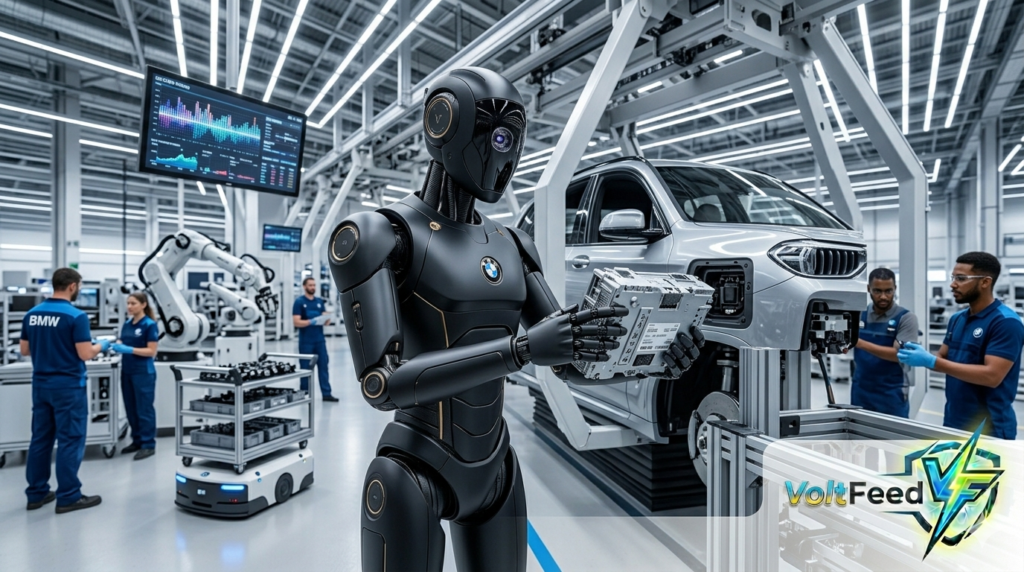
Companies like Apptronik with their Apollo robot, and Boston Dynamics with the Electric Atlas, are developing humanoids specifically for industrial manipulation tasks, including heavy-duty work. BMW Group, for instance, has launched pilot projects with humanoid robots like AEON and Figure 02 in its Leipzig and Spartanburg plants, where they assist in production, deliver materials, and navigate around obstacles.
Transformative Benefits for the Manufacturing Sector
The adoption of humanoid robots in factories offers numerous benefits that are poised to revolutionize the manufacturing sector:
- Increased Efficiency and Productivity: Humanoid robots can perform tasks with high precision and speed, operating 24/7 without fatigue, which significantly reduces production time and increases output.
- Improved Workplace Safety: By taking on dangerous, heavy, or repetitive tasks, humanoid robots reduce human exposure to hazards. OSHA data shows factories deploying humanoid robotics have cut exposure-related incidents by over 50%, and automation-heavy plants have seen injury rates drop by 35%. This not only protects workers but also helps companies comply with safety regulations.
- Enhanced Flexibility and Adaptability: Unlike traditional, fixed automation, humanoids can adapt to various tasks and environments without requiring costly re-engineering of the factory floor. Their human-like form allows them to use existing tools and operate within spaces scaled for people.
- Addressing Labor Shortages: With millions of unfilled positions in sectors like manufacturing and logistics, humanoid robots can fill labor gaps, maintain production continuity, and allow human workers to focus on higher-value, creative, and strategic tasks.
- Cost Optimization: While initial costs can be high, the ROI periods for humanoid deployment have dropped from 5.3 years in 2019 to just 2.8 years in 2023. Companies using AI-powered humanoid robots report labor cost reductions of 22–28% within the first year. Unit costs are also projected to fall significantly, making them economically viable within five years.
- Enhanced Quality: Equipped with advanced sensors and algorithms, humanoid robots minimize errors and ensure consistency in tasks, reducing the need for rework and improving overall product quality.
Navigating Challenges and Glimpsing the Future
Despite the immense promise, integrating humanoid robots in factories comes with its share of challenges.
- Cost: Current humanoid robotic devices can range from $80,000 to over $300,000 per unit, excluding integration costs. While costs are decreasing, they remain a significant investment for many companies.
- Technological Limitations: Current models may not yet match human versatility, speed, and endurance for all complex, high-demand tasks. Issues like limited battery life, overheating joint motors, and accelerated gearbox wear can impact operational duration and scalability.
- Integration Complexity and Safety: Ensuring seamless and safe interaction with human workers in dynamic, fast-paced environments requires extensive testing. While designed for collaboration, the perception of risk needs to be managed.
- Perception vs. Practicality: As Ayanna Howard, Dean of The Ohio State University’s College of Engineering and an AI expert, notes, there’s often a significant gap between impressive prototypes and deployable, cost-effective solutions.
However, the future for humanoid robots in factories appears bright. The industry is rapidly moving from trade-show demonstrations to structured pilot deployments. We anticipate adoption to scale first in industrial environments, particularly automotive manufacturing and logistics, before expanding into broader markets. The focus is on human-robot collaboration (HRC), where humanoids complement people by taking on repetitive or dangerous tasks, allowing employees to focus on higher-value, creative work.
The continuous advancements in AI, machine learning, and sensor technology will further enhance their capabilities, making them more autonomous, adaptable, and capable of natural interaction through voice commands and intuitive interfaces. As NVIDIA CEO Jensen Huang suggests, the rise of intelligent, adaptable robots could be as significant as the launch of the internet or the smartphone.
Frequently Asked Questions (FAQ)
Q: Are humanoid robots replacing human jobs in factories?
A: The primary goal of humanoid robots in factories is not to entirely replace human workers but to augment human capabilities and address critical labor shortages. They are designed to take on repetitive, dangerous, or physically demanding tasks, allowing human employees to focus on higher-value, creative, and strategic work.
Q: What tasks can humanoid robots perform in a factory?
A: Humanoid robots can perform a growing range of tasks, including material handling (picking, palletizing), machine tending, assembly assistance, quality control, inspection, and working in hazardous environments.
Q: How much do humanoid robots cost?
A: Current humanoid robotic devices can cost between $80,000 and over $300,000 per unit, excluding integration costs. However, prices are projected to fall significantly, with some models aiming for around $30,000, and potentially reaching $15,000 in lower-income countries by 2050.
Q: Are humanoid robots safe to work alongside humans?
A: Yes, modern humanoid robots are designed with advanced sensors and safety mechanisms, including force control, to enable safe collaboration with human workers without needing extensive physical barriers or redesigned workspaces.
Conclusion
The integration of humanoid robots in factories marks a significant leap in industrial automation. While challenges related to cost, technological maturity, and seamless integration remain, the transformative benefits are undeniable. We are moving towards a future where humanoids will be integral partners on the factory floor, enhancing safety, boosting productivity, and enabling a more flexible and resilient manufacturing sector. This isn’t just about advanced machinery; it’s about a collaborative ecosystem where humans and robots work side-by-side, driving innovation and shaping the next chapter of smart manufacturing.