We are witnessing a pivotal moment in the evolution of artificial intelligence and robotics with the emergence of Tesla Optimus Gen 3 Production. Tesla’s humanoid robot, Optimus, is no longer a mere concept; it’s rapidly transitioning into a tangible reality, poised to redefine industries and daily life. Elon Musk, CEO of Tesla, has boldly declared Optimus to be potentially the “biggest product ever made,” hinting at its transformative potential far exceeding the company’s automotive ventures. This ambition is now backed by concrete production milestones, signaling a new era where general-purpose humanoid robots could integrate into our world at an unprecedented scale.
Production Milestones and Advanced Capabilities of Gen 3
The journey of Tesla Optimus Gen 3 Production marks a significant acceleration in Tesla’s robotics program. Mass production of Optimus Gen 3 officially commenced at Tesla’s Fremont, California factory on January 21, 2026. This initial phase is crucial, with Tesla targeting the production of between 50,000 and 100,000 units in 2026. The Fremont factory aims to achieve a remarkable 1 million units/year run-rate by the end of 2026.
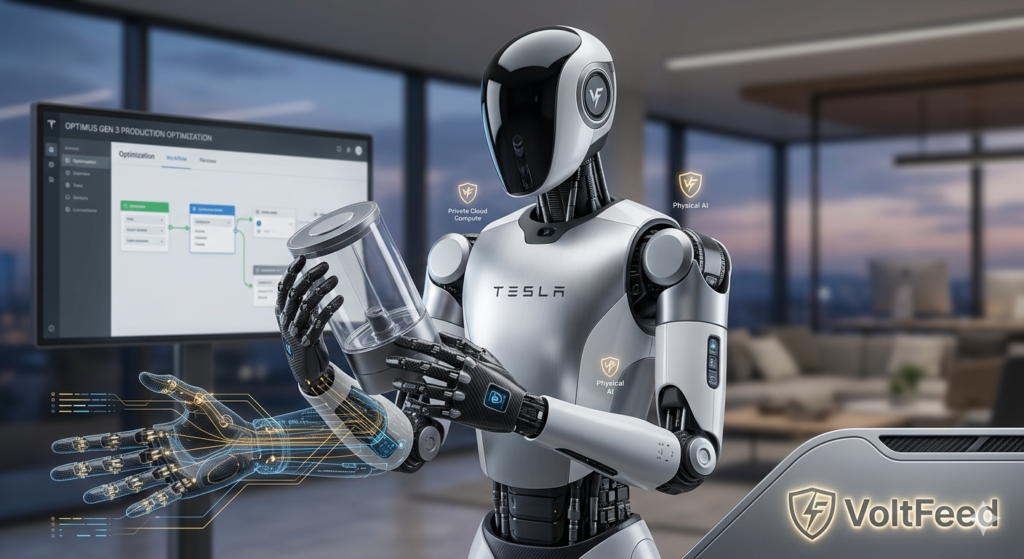
A key technical breakthrough for Gen 3 is its highly advanced hand system. Confirmed production-ready on February 17, 2026, the Gen 3 hands boast an impressive 22 degrees of freedom (DoF) in the fingers, coupled with additional wrist articulation. This represents a substantial leap from earlier generations, which featured 11 DoF, enabling the robot to perform complex manipulation tasks that were previously challenging. Tesla engineers have indicated that the V3 hand is “getting very close to human functionality and form factor,” with the finished robot potentially resembling “a human in a superhero suit.”
Full production of Optimus V3 is anticipated to begin in Summer 2026, with a rapid scaling of high-volume production projected throughout 2027. To support these ambitious targets, Tesla is repurposing its Model S and Model X production lines at the Fremont factory. Furthermore, a dedicated Optimus factory is under construction at Giga Texas, designed with an astonishing capacity for 10 million units annually, with mass production there slated for 2027.
The Optimus robot is fundamentally designed to be a general-purpose, bipedal, and autonomous humanoid capable of performing tasks that are unsafe, repetitive, or simply boring for humans. Its AI capabilities are deeply integrated with Tesla’s Full Self-Driving (FSD) architecture, leveraging advanced computer vision and neural networks. Tesla has also shifted its training methodology to a vision-only approach, utilizing video recordings of employees to teach the robot tasks, mirroring the strategy employed for its autonomous vehicles.
Here’s a snapshot of the Optimus Gen 3 production roadmap:
MilestoneTarget/StatusDate/TimelineGen 3 Mass Production StartFremont FactoryJanuary 21, 2026Gen 3 Hand System Production-Ready22 DoF fingers + wrist articulationFebruary 17, 2026Full V3 Production StartSummer 20262026 Production Target50,000 – 100,000 unitsEnd of 2026Fremont Run-Rate Capacity1 million units/yearEnd of 2026Giga Texas Optimus Factory10 million units/year capacity, under constructionMass production 2027First B2B Commercial SalesEstimated >$100,000/unitLate 2026Long-term Manufacturing Cost<$20,000/unit at scaleLong-term goal
Future Impact, Applications, and Economic Outlook
The implications of Tesla Optimus Gen 3 Production reaching mass scale are profound, promising to reshape global labor markets and economic structures. Elon Musk envisions Optimus as a tool that could fundamentally alter the economics of labor and manufacturing, potentially generating up to $10 trillion in revenue for Tesla and even playing a role in eliminating poverty by significantly reducing the cost of goods and services.
Early applications for Optimus are concentrated in industrial settings, including:
- Manufacturing assembly
- Material handling and quality inspection
- Logistics tasks such as loading, unloading, sorting, and transporting goods in warehouses and distribution centers
As the technology matures, Tesla’s long-term vision extends to Optimus penetrating household, medical, and broader logistics scenarios, aiming for a rollout scale comparable to that of smartphones. The robot’s ability to perform repetitive, physically demanding, or dangerous tasks is expected to increase efficiency and reduce costs across various industries.
Economists and analysts are closely watching, with some estimating the humanoid robot market could present a $5 trillion opportunity by 2050. This transition, while gradual, suggests a future where robots could eventually replace millions of jobs, particularly those involving routine physical labor. However, this also opens doors for new technologies and higher-value work, fundamentally altering how economies distribute wealth.
Tesla’s competitive advantage in this space is underpinned by its expertise in real-world AI, refined through its autonomous vehicles, and its robust vertical integration across components like batteries, power electronics, and manufacturing. This allows for rapid scaling and a structural cost advantage.
Frequently Asked Questions (FAQ)
When did Tesla Optimus Gen 3 Production officially start?
Mass production of Optimus Gen 3 officially began at Tesla’s Fremont factory on January 21, 2026.
What are the key features of Optimus Gen 3?
Optimus Gen 3 features a highly dexterous hand system with 22 degrees of freedom in the fingers and additional wrist articulation, significantly improving its manipulation capabilities. It also boasts enhanced AI integration based on Tesla’s FSD architecture and a lighter design.
How many Optimus robots does Tesla plan to produce?
Tesla aims to produce 50,000 to 100,000 units in 2026, with the Fremont factory targeting a 1 million units/year run-rate by the end of 2026. A dedicated factory at Giga Texas is planned for 10 million units annually by 2027.
What will be the initial cost of an Optimus robot?
Initial B2B commercial sales are estimated to be above $100,000 per unit, expected in late 2026. Tesla’s long-term manufacturing cost target at scale is below $20,000 per unit.
What tasks will Optimus Gen 3 be capable of performing?
Optimus is designed for general-purpose tasks, including repetitive, dangerous, or boring jobs in manufacturing, material handling, quality inspection, and logistics. Long-term goals include household, medical, and broader service applications.