Additive manufacturing, commonly known as 3D printing, has been steadily transforming industries, offering new possibilities for design, prototyping, and production. For a decade, HP has been at the forefront of this revolution with its Multi Jet Fusion (MJF) technology. Now, as we mark a significant milestone in additive manufacturing, HP is poised to further broaden access to industrial-grade 3D printing with the introduction of the HP MJF 1200 3D Printer. This new solution represents a strategic move to bring the power of industrial MJF technology into more workspaces, democratizing advanced manufacturing capabilities for a wider audience.
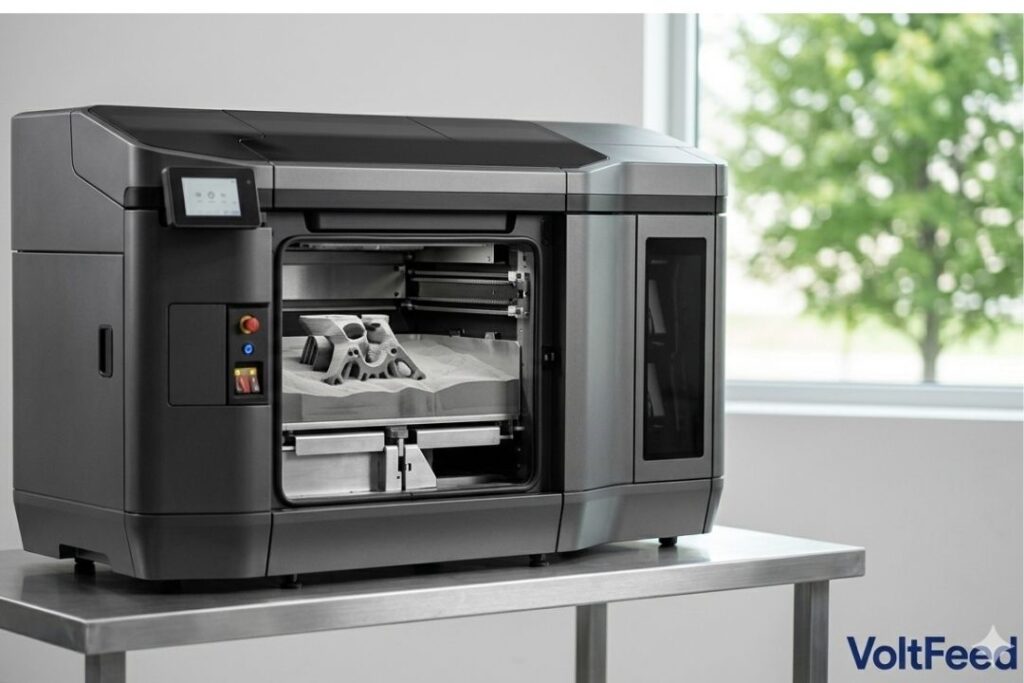
Introduction to the HP MJF 1200 3D Printer: Expanding Industrial Accessibility
The landscape of manufacturing is continually evolving, driven by demands for greater efficiency, customization, and faster time to market. HP’s Multi Jet Fusion technology has been a key player in this transformation, offering a robust solution for producing high-quality, functional parts. Building on this legacy, HP announced the HP Multi Jet Fusion 1200 3D Printer Solution at RAPID+TCT on April 14, 2026. This compact system is specifically designed to expand accessibility to HP’s industrial Multi Jet Fusion capabilities, making it easier for diverse teams to leverage the benefits of advanced additive manufacturing.
We believe that when the right tools are placed in the hands of innovators, the potential for impact is immense. The HP MJF 1200 3D Printer aims to do just that, delivering the same core MJF technology found in HP’s existing industrial portfolio but in a smaller, more affordable package. This strategic introduction is set to empower more organizations to produce strong, functional polymer parts suitable for real-world applications, accelerating innovation and fulfilling demanding production needs.
Key Innovations and Impact of the HP MJF 1200
The HP MJF 1200 3D Printer stands out through its focus on accessibility without compromising the industrial-grade performance synonymous with HP’s Multi Jet Fusion technology. A primary innovation lies in its compact design, which allows it to integrate into a wider range of workspaces, moving industrial additive manufacturing closer to the point of innovation. This is a significant shift, as many industrial 3D printers traditionally require substantial space and infrastructure.
Beyond its smaller footprint, the HP MJF 1200 solution incorporates several features aimed at simplifying the end-to-end additive manufacturing process. It comes supported by an ecosystem of hardware and software, including Magics Print for HP, a dedicated build-preparation software powered by Materialise and integrated into the CO-AM Ecosystem. This tailored software provides professional-grade tools for nesting, part orientation, and build layout, enabling users to prepare builds quickly and efficiently, streamlining the path from design to printed part.
Furthermore, the HP MJF 1200 3D Printer features automated processes for material mixing, build preparation, and part unpacking, which helps reduce manual intervention and maintain a clean working environment. This ease of use, combined with industrial-grade performance, has been appreciated by early users, who note its ability to deliver quality parts in a compact format without requiring changes to existing workflows.
The impact of this printer extends beyond its individual features. It represents a scalable entry point into HP’s broader MJF portfolio, allowing companies to develop in-house capabilities while still leveraging HP’s global network of MJF production partners for higher volume needs. Multi Jet Fusion technology itself offers several overarching advantages that the 1200 model inherits:
- Speed: MJF technology can produce parts significantly faster than many other 3D printing methods, making it suitable for both rapid prototyping and production.
- Detail and Precision: With a print resolution of up to 1200 dpi in the X and Y axes, MJF technology enables the production of intricate details, fine features, and sharp edges.
- Mechanical Properties: Parts produced with MJF exhibit excellent mechanical properties, including strength, durability, and impact resistance, often with near-isotropic strength across all axes.
- Material Efficiency: The ability to reuse up to 80% of unfused powder reduces material waste and lowers overall production costs.
- Design Freedom: MJF does not require support structures, allowing for the creation of complex internal channels, lattices, and assemblies.
These innovations collectively reinforce HP’s commitment to lowering barriers to adoption and enabling customers to scale from prototyping to full production.
Frequently Asked Questions
What is the HP MJF 1200 and when will it be available?
The HP MJF 1200 3D Printer is a newly introduced compact additive manufacturing solution designed by HP to make its industrial-grade Multi Jet Fusion technology more accessible. It was announced on April 14, 2026, at the RAPID+TCT event. The printer delivers the same core MJF technology as HP’s larger systems but in a smaller, more affordable unit. It features a 12-liter build volume, which is notably more compact than the 41-liter build units typically found in the HP MJF 4200 through 5600 series.
Regarding its availability, the full solution for the HP Multi Jet Fusion 1200 3D Printer is planned to be available from early 2027.
What are the main advantages of the HP MJF 1200?
The main advantages of the HP MJF 1200 3D Printer stem from its design as an accessible, industrial-grade system:
- Increased Accessibility: Its compact size and expected affordability make industrial MJF technology accessible to a broader range of workshops and design teams.
- Industrial-Grade Performance in a Compact Format: It delivers the proven strength and functionality of HP’s Multi Jet Fusion parts, allowing teams to produce robust polymer components suitable for real-world applications.
- Simplified Workflow: Automated processes for material mixing, build preparation, and part unpacking reduce manual labor and simplify integration into existing facilities.
- High Resolution and Detail: Leveraging core MJF technology, it offers high-resolution printing, typically up to 1200 dpi, enabling precise geometries and fine details.
- Material Efficiency: The technology’s ability to recycle unused powder significantly reduces material waste and operational costs.
- Scalable Entry Point: It serves as an excellent starting point for companies looking to bring additive manufacturing in-house, with compatibility for scaling up to HP’s larger MJF production network as needs grow.
What types of applications is it suitable for?
The HP MJF 1200 3D Printer is suitable for a wide array of applications, bridging the gap between prototyping and end-use part production. Its ability to produce strong, functional polymer parts makes it ideal for:
- Functional Prototypes: Rapidly creating functional prototypes for testing and validation, significantly reducing time to market.
- End-Use Parts: Manufacturing end-use components, particularly for low to medium production volumes, where it offers a cost-effective alternative to traditional methods like injection molding.
- Customization and Personalization: Supporting mass customization, allowing for tailored parts without additional tooling costs.
- Complex Geometries: Ideal for parts with intricate designs, complex surfaces, internal shapes, and moving subcomponents like gears, rotational joints, and sliders, due to its no-support-structure requirement.
Common applications across various sectors include:
- Housings, Brackets, and Fixtures: Producing durable components for machinery and electronics.
- Assemblies: Creating functional assemblies and connectors.
- Specialized Industries: Applicable across sectors such as aerospace, oil and gas, medical, automotive, and industrial manufacturing, especially for demanding applications that require high-temperature materials and robust performance.
- Consumer Products: Recent examples of MJF technology applications include drone parts, footwear, and custom bike saddles, utilizing materials like flexible TPU.
The versatility of HP’s Multi Jet Fusion materials, such as HP 3D High Reusability PA 12, PA 11, PA 12 Glass Beads, and Polypropylene (PP), further expands its application suitability for parts requiring chemical resistance, flexibility, or enhanced dimensional stability.